How 3D Jewelry Rendering Drives Sales and Boosts Conversions?
How Do Jewelry Brands Build Buyer Confidence Without the In-Store Experience?
For decades, jewelry purchases have been guided by in-store evaluation. Buyers relied on assisted try-ons, close visual inspection under multiple lighting conditions, and tactile assessment to validate quality, fit, and craftsmanship. As the jewelry eCommerce market expands at 12.5% CAGR (2024-2032), brands face a fundamental challenge: replicating confidence-driven purchase behavior in a digital environment where physical inspection is not possible.
This gap has accelerated the adoption of 3D jewelry rendering. High-fidelity 3D renders enable brands to communicate craftsmanship, material accuracy, scale, and fit with precision, reducing uncertainty and enhancing buyer confidence at critical decision points.
This blog examines why jewelry brands are investing in 3D renders, the industry trends driving adoption, and how brands can strategically leverage 3D jewelry rendering services to create high-quality product visuals that support long-term sales growth.
Why are Brands Investing in 3D Jewelry Renders?
1. Rising Consumer Expectations for Interactive Shopping Journeys
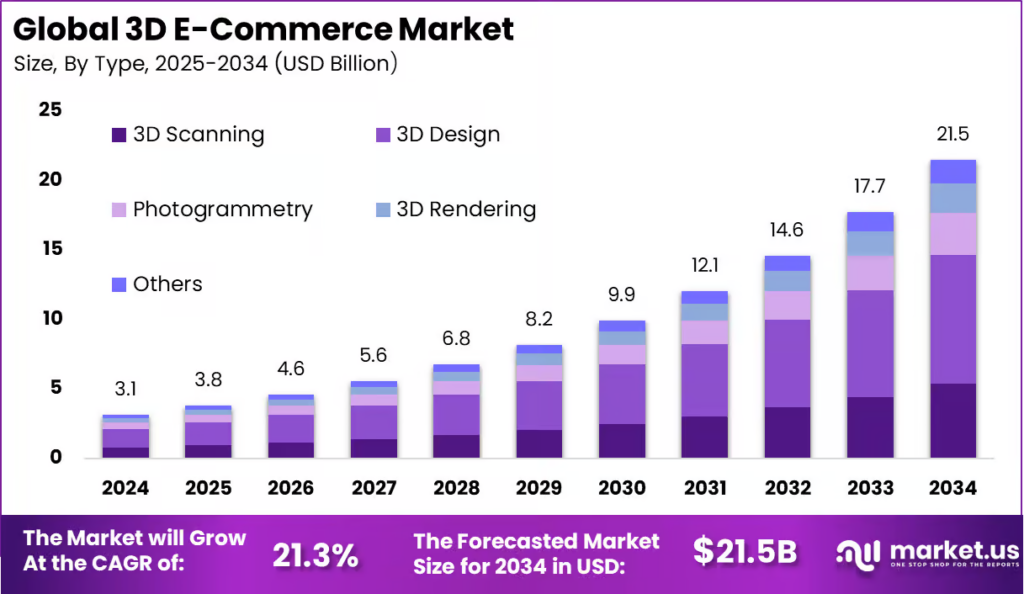
According to a report by Market.us, the global 3D eCommerce market is projected to grow at a 21.3% CAGR, reaching $21.5 billion by 2034.
The shift from static physical catalogs to 3D renders empowers customers with a more interactive shopping experience. 3D renders allow buyers to view jewelry from multiple angles, zoom in on intricate details, and explore variations such as different metals or stones—features that static images cannot offer. This level of interactivity helps customers better understand the product, reducing uncertainty and increasing the likelihood of a purchase.
2. Cost and Speed Efficiency Over the Product Lifecycle
3D renders optimize costs and time throughout the product lifecycle, enabling jewelry brands to streamline operations and accelerate go-to-market timelines. Here’s how:
- No Need for Photoshoots or Samples: 3D renders are generated directly from digital models, eliminating the need for physical samples or photoshoots.
- Accelerated Time-to-Market: With rapid iterations and adjustments, 3D renders enable brands to modify materials, colors, and details instantly in the digital environment, allowing real-time revisions and updates.
- Reduced Operational Costs: As designs are created digitally, there are no costs for material sourcing, transportation, or studio setup, resulting in reduced costs throughout the production cycle.
3. Enhanced Scalability
3D renders enable scalability by leveraging cloud-based rendering and single-asset systems. Cloud platforms provide on-demand access to powerful render farms, allowing brands to scale production efficiently, without significant hardware investments.
Additionally, a single 3D model serves as the core asset, from which endless variations can be generated. Whether it’s different colors, angles, or materials, brands can create consistent visuals across various platforms (eCommerce, AR, print), providing an efficient and cost-effective way to manage and scale product lines.
4. Dynamic Digital Assets for Integrated Marketing
3D renders enable brands to create a wide variety of marketing assets efficiently and cost-effectively. With a single digital asset, brands can generate content that meets the needs of different platforms and formats.
- Generate infinite product variations, including different colors, materials, and textures, without reshoots.
- Adjust aspect ratios, resolutions, and file types for diverse formats, from social media to print materials.
- Create interactive content such as 360° spins, AR experiences, and virtual showrooms to enhance engagement.
- Ensure consistent branding by controlling key visual elements like lighting, shadows, and product details across all channels.
Key Benefits of 3D Jewelry Rendering for Brands
#1 Enhanced Buyer Confidence
- Photorealistic Detail: 3D jewelry rendering techniques simulate metal reflectivity, gemstone refraction, and surface finishes, enabling buyers to assess prong work, stone placement, polish quality, and clarity with accuracy.
- Multiple Perspectives: Interactive 3D views let buyers inspect jewelry from top, side, and close-up angles, eliminating guesswork around setting height, stone depth, and band thickness, while enhancing the overall product experience.
- Material Accuracy: Digital renders ensure metals and gemstones are represented consistently, giving buyers confidence that what they see aligns with what they will receive, significantly reducing perception gaps.
#2 Improved Jewelry Sales with 3D Visualization
Photorealistic 3D visuals align buyer expectations by accurately representing products, reducing return rates caused by appearance mismatches. Interactive content boosts engagement, increasing time spent on product pages—an indicator of stronger purchase intent. With a clearer understanding of the product, buyers feel more confident, leading to higher add-to-cart rates and ultimately sales.
#3 Brand Positioning and Competitive Differentiation
- Elevated Brand Perception: High-quality 3D visuals signal professionalism, precision, and attention to detail, reinforcing a premium brand image.
- Content Versatility Across Channels: 3D renders can be repurposed across marketing channels—eCommerce, social media, paid ads, and digital lookbooks—ensuring consistent, engaging content.
- Clear Differentiation in Competitive Markets: Interactive, high-quality visuals distinguish products from static listings, improving visibility and brand recall in crowded categories.
#4 Customization at Scale with 3D Configurators
3D rendering enables jewelry brands to offer customized jewelry at scale by creating a library of base designs that can be easily modified. For example, a brand might offer a pre-designed engagement ring or bracelet, allowing customers to select options such as stone type, metal choice, or engraving.
Through interactive 3D configurators, customers can visualize and modify their jewelry in real-time, giving them complete control over design elements. This efficient digital process allows brands to meet customer demands for customization while maintaining cost-effectiveness and fast production timelines.
How to Assess the Quality of 3D Jewelry Renders?
| Factor | Production-Ready 3D Renders | Inaccurate 3D Renders |
|---|---|---|
| Color Accuracy | Precise calibration of metal and gemstone colors, matching the actual product. | Colors appear inconsistent or unrealistic, leading to misrepresentation. |
| Lighting and Shadows | Realistic lighting simulates true reflection, creating natural shadows and depth. | Uneven lighting distorts the jewelry, making it difficult to accurately assess its shape and details. |
| Surface Detail | Detailed textures and finishes (e.g., polished metal, gemstone clarity). | Lack of texture detail, resulting in flat, unrealistic surfaces. |
| Reflections and Highlights | Accurate reflections and highlights on metals and gemstones, enhancing realism. | Incorrect or exaggerated reflections can distort product details, making it difficult to assess the jewelry. |
| Visual Clarity | Clean presentation with clear focus on the jewelry, free from distractions. | Cluttered backgrounds or unclear product visuals that distract from the jewelry. |
| Resolution and Quality | High resolution and sharpness, suitable for all marketing materials. | Low resolution or visible artifacts, making it unsuitable for professional use. |
What are the 3D Jewelry Rendering Trends in 2026?
1. Interactive 360° Views as Standard
Interactive 360° views are becoming a standard feature for jewelry brands, enabling customers to inspect products from all angles. By enabling a dynamic, user-controlled experience, this technology helps brands improve jewelry sales with 3D visualization, as buyers increasingly expect this level of engagement for high-value purchases.
2. Augmented Reality (AR) Try-On for Immersive Experience
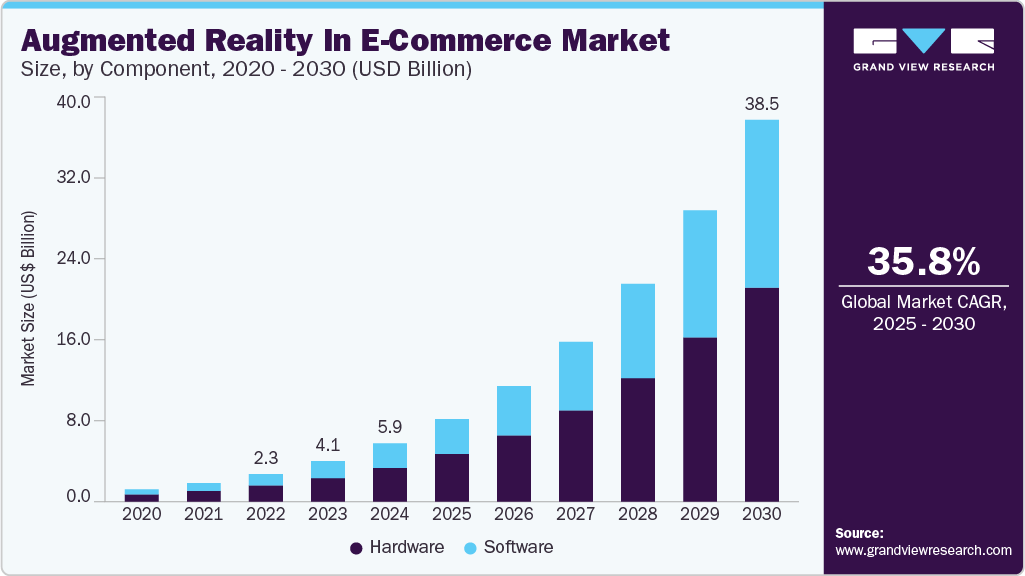
The augmented reality market in eCommerce is expected to grow at a 35.8% CAGR, reaching $38.5 billion by 2030, underscoring its growing significance in modern online shopping. This technology allows users to accurately visualize product fit, scale, and style in real time. By using 3D rendering, brands add depth and realism to jewelry, making it appear almost indistinguishable from real life.
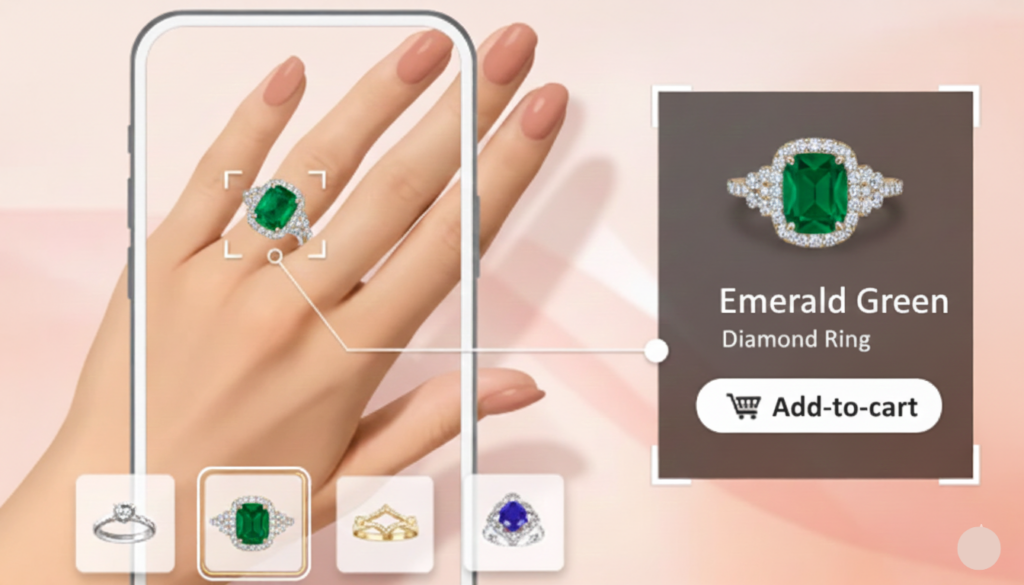
As a result, it builds buyer confidence, boosts conversion rates, and reduces returns by giving customers a clearer understanding of how the jewelry will look and feel in real life.
3. Real-Time 3D Jewelry Rendering
Real-time 3D jewelry rendering is rapidly becoming a must-have for jewelry brands seeking to enhance customer experiences. This technology allows brands to create interactive, photorealistic visualizations of jewelry instantly, enabling customers to try on items virtually, customize materials (like gold and gems), and see how light interacts with the jewelry’s facets. By providing a true-to-life preview in real-time, it helps customers make informed decisions, ultimately boosting engagement and conversion rates.
How to get Started With 3D Renders for Your Jewelry Brand?
- Define Your Objectives: Identify products that require better visualization, have higher value, or involve complex variations.
- Streamline the Production Process: Focus on CAD review, model optimization, material configuration, and rendering to achieve accurate results.
- Ensure Technical Accuracy: Partner with 3D jewelry rendering services to ensure high-quality, precise visuals that align with your brand.
- Quality Assurance: Conduct thorough checks for consistency and realism to ensure compliance with the highest standards.
How Does PicsMatic Help with 3D Jewelry Rendering Services?
PicsMatic offers specialized 3D jewelry rendering services designed for eCommerce brands. Here’s how;
- End-to-End 3D Rendering: From product reference images, sketches, and CAD drawings to detailed design specifications, we deliver precise, lifelike 3D jewelry renders that align with your brand’s vision.
- Industry-Standard Tools: Using advanced tools like Blender, Maya, and KeyShot, we produce detailed renders that accurately reflect materials, finishes, and lighting, enhancing product realism.
- Platform-Ready Assets: Our 3D renders are optimized for web, mobile, AR try-ons, interactive configurators, and marketing campaigns, ensuring consistency across channels.
- Customization Capabilities: We design 3D configurators that enable customers to personalize jewelry in real time, making the shopping experience more interactive and engaging.
- Data Quality & Security: We are ISO 27001:2022 certified for data security management systems and ISO 9001:2015 for quality management systems.
Request a Free Sample Or Share Your Project Requirements! |